
AI and restructuring make organizations faster — and, handled carelessly, faster at repeating what they already know. Reorgs flatten decision layers and remove the people who carried context; automation absorbs the analysis. The efficiency shows up immediately. The lost judgment shows up later — as brittle decisions and slowed innovation.
A leaner, AI-augmented organization only outperforms if the people inside it can still reason well. The next advantage won’t come from automation alone, but from pairing AI with human judgment, business context, and critical thinking. And the good news for anyone leading this work: judgment isn’t innate — it’s a set of behaviors that can be taught.
Coordination quietly replaced judgment
For two decades, many managers were trained into a coordination-heavy style of work — dashboards, workflow tools, performance reports. Visibility improved, but the manager’s role often shifted from deeply understanding the business to tracking metrics and escalating exceptions. Metrics aren’t judgment: a report shows a target was missed, but not why a customer response mattered or how a trade-off should be weighed. AI sharpens the problem — if the human layer no longer carries strong reasoning, AI outputs get accepted too quickly and questioned too little.
The innovation risk — sharpened by restructuring
Lean on data and automation too heavily and an organization gets better at reproducing yesterday’s patterns and worse at creating tomorrow’s opportunities. Restructuring raises the risk: reorgs remove the very people who carried context and recognized nuance before a bad decision scaled. The transformation succeeds on paper and underperforms in practice. Closing that gap is an enablement problem — and a solvable one.
Where durable human advantage actually lives
Rigor/Relevance
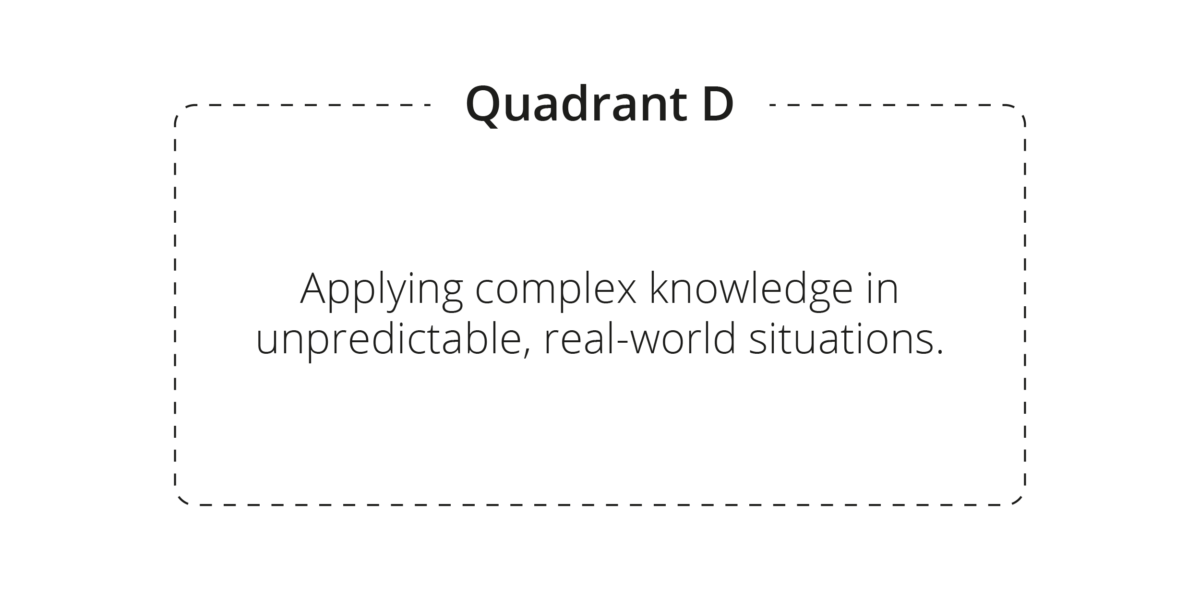
Dr. Bill Daggett’s framework plots how deeply a person thinks against how far they apply it to messy, real situations. AI now floods the recall, routine application, and much of the analysis.
What it cannot reach is Quadrant D — high-level judgment in ambiguous situations where the rules aren’t written. That’s where the scarce human work lives.
The Trust Equation
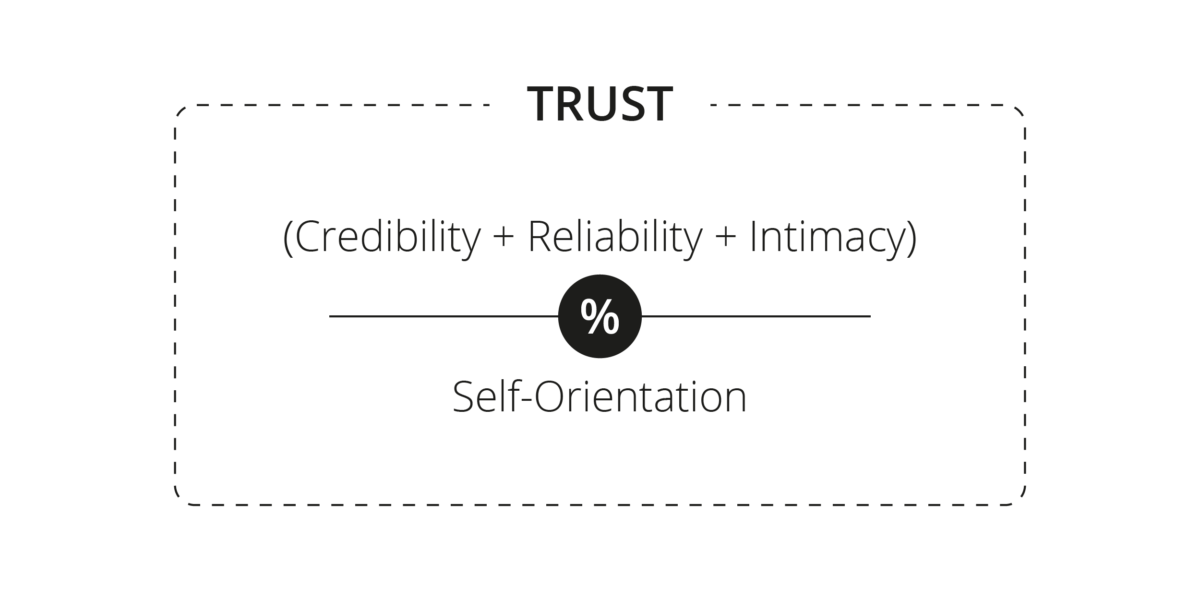
Charles H. Green places credibility, reliability, and intimacy over self-orientation. AI made the numerator cheap — anyone can produce credible-sounding output.
What it can’t do is hold down the denominator. Low self-orientation — genuinely seeing the problem from the other side — is the hardest part of trust to earn, and in relationship-driven businesses like the IT channel, it’s the entire moat.
The proof that judgment is teachable
A useful proof point: neurodivergent professionals have quietly become the workforce’s most demanding AI users (78% use AI at work vs 59% of neurotypical peers, Understood.org 2026) — and they use it differently, interrogating it and finding where it fails.
The lesson isn’t “some brains are built for this.” It’s that AI power-use runs on five behaviors anyone can learn: Interrogation, Decomposition, Divergence, Reframing, and Rebuilding. That converts an identity claim into a capability claim — and meta-analyses (one spanning 117 studies, 20,000+ participants) find critical and divergent thinking respond strongly to explicit instruction, especially when practiced on real work.
What transformative leaders actually need to learn
- Business literacy. The economics and context that define a good decision.
- Critical thinking. Questioning fluent answers, generating alternatives, finding the edges.
- Judgment frameworks. Shared mental models that let a team reason about ambiguity at speed.
- AI fluency. Knowing what to delegate, what to withhold, and how to redesign the workflow.
The goal isn’t skeptical managers who reject technology. It’s managers who can use technology without surrendering their responsibility to think.

How we build it: AMPED, then the Human Edge
MMG trains the five behaviors tactically through AMPED — a short workshop where each framework replaces a common AI mistake — and embeds them strategically through the Human Edge, a multi-month capability engagement built on the Trust Equation and Rigor/Relevance. AMPED proves the methodology in a few hours on the team’s real work; the Human Edge makes it durable. The claim isn’t “we ran a workshop” — it’s “we measurably built judgment,” scored against a decision rubric before and after.
The future of management isn’t data-driven or AI-driven — it’s judgment-enabled, and the moat can be taught.
Drop us a line
Have something to say? We’d love that.
Contact us here.