
In January 2025, a Chinese startup called DeepSeek released an AI model that reportedly matched the American frontier at a fraction of the training cost — and the market panicked. If AI just got that much cheaper, surely demand for expensive AI infrastructure was about to collapse.
Satya Nadella’s response was two words: “Jevons paradox strikes again!” Microsoft’s CEO reached past the panic for a 160-year-old observation about coal and predicted the opposite of what the market feared — that cheaper, more efficient AI would make demand skyrocket, not shrink.
He was right. And he stopped one layer too early.
The coal that wouldn’t disappear
In 1865, the English economist William Stanley Jevons noticed something that broke everyone’s intuition. As steam engines got more efficient — burning less coal to do the same work — England didn’t burn less coal. It burned dramatically more. Cheaper steam power made steam economical for uses that had never made sense before, and the new demand blew past every efficiency gain.
That’s Jevons Paradox: when you make a resource cheaper to use, total consumption of it tends to rise, not fall. Efficiency doesn’t shrink the thing it makes cheap. It detonates it.
The modern textbook case is lighting. Over two centuries the cost of artificial light collapsed by orders of magnitude — candles to gas to filament to LED. We didn’t respond by lighting our lives the same amount for less money. We lit everything, all the time: parking lots, screens, skylines, the insides of refrigerators. Efficiency didn’t reduce our consumption of light. It exploded it.
Cognition is the new coal
Nadella applied Jevons to compute — the chips and power AI runs on. That’s correct, and it’s also the safe, obvious layer. Run the same logic up one level, to the thing the compute actually produces, and it gets far more interesting.
AI is an efficiency shock to cognition — the drafting, summarizing, analyzing, and first-passing that used to eat a Tuesday. The naive read is the same one the market got wrong about coal: cheaper cognition means we’ll need less of it.
Watch what actually happens. When the cost of producing a strategy, an analysis, or a proposal collapses toward zero, the volume of them explodes. More options on every table. More versions of every plan. More content than anyone can read, let alone act on. AI didn’t reduce the amount of thinking an organization has to do. It multiplied it — and then handed the multiplication to people who now have to figure out which of it is any good.

The receipts are already in
This isn’t a forecast. The flood is already measurable, and the numbers are getting hard to ignore.
- 95% of enterprise generative-AI pilots delivered no measurable P&L impact — against an estimated $30–40B in spending (MIT NANDA, The GenAI Divide, 2025). The failures weren’t about model quality. They were about organizations drowning in cheap output they couldn’t integrate, evaluate, or trust.
- $186 per employee, per month lost to “workslop” — AI-generated content that looks polished but lacks the substance to move a task forward. Around 40% of workers had been handed it in the previous month, each instance costing nearly two hours to untangle (Harvard Business Review · BetterUp Labs · Stanford, 2025). The fix requires exactly the human checking AI was supposed to eliminate.
- 42% trusted the sender less after receiving workslop (BetterUp–Stanford survey).
At the macro level the picture rhymes. Reviewing Q4 earnings in early 2026, Goldman Sachs economist Ronnie Walker found no meaningful economy-wide relationship between AI adoption and productivity — even as talk of AI drowned out an otherwise strong quarter. Everyone is producing more. No one can yet show it added up to more value. That gap — between exploding output and stalled value — is Jevons Paradox with the receipts attached.
What gets scarce when everything gets cheap
When something becomes abundant and nearly free, its value doesn’t evaporate — it migrates to the adjacent scarcity. Cheap water didn’t make plumbers poor; it made them essential. Cheap information didn’t make editors obsolete; it made anyone with taste indispensable. Abundance creates a new bottleneck one layer out, and that’s where the value pools.
So when AI makes answers abundant, ask the only question that pays: what’s the adjacent scarcity? It isn’t more answers. It’s the ability to decide which answer is worth acting on — and whether the question was even the right one. Every cheap option is a new decision that needs an owner. The binding constraint is no longer producing the analysis. It’s owning the call.

The honest part: the trap in the easy version of this argument
Let me be honest about where this reasoning is fragile, because the sloppy version is everywhere and it won’t survive a serious skeptic.
The sloppy version says judgment is safe because AI can’t judge as well as a human. Do not build on that. Judgment is a form of cognition, and cognition is precisely the thing getting cheap. Betting your career on “the machine will never think as well as I do” is betting on a shoreline — and the tide is coming in.
The defensible version is sturdier. It isn’t that AI can’t judge. It’s that AI cannot be held accountable. Someone still has to own the decision, carry the relationship, and be answerable when it goes wrong. That isn’t a skill AI happens to lack — it’s a role it categorically cannot occupy. You can hand a model the analysis. You cannot hand it the consequences. That distinction is the whole ballgame: the moat holds even if the models get genuinely, frighteningly good.
Trust, doing exactly what it was built to do
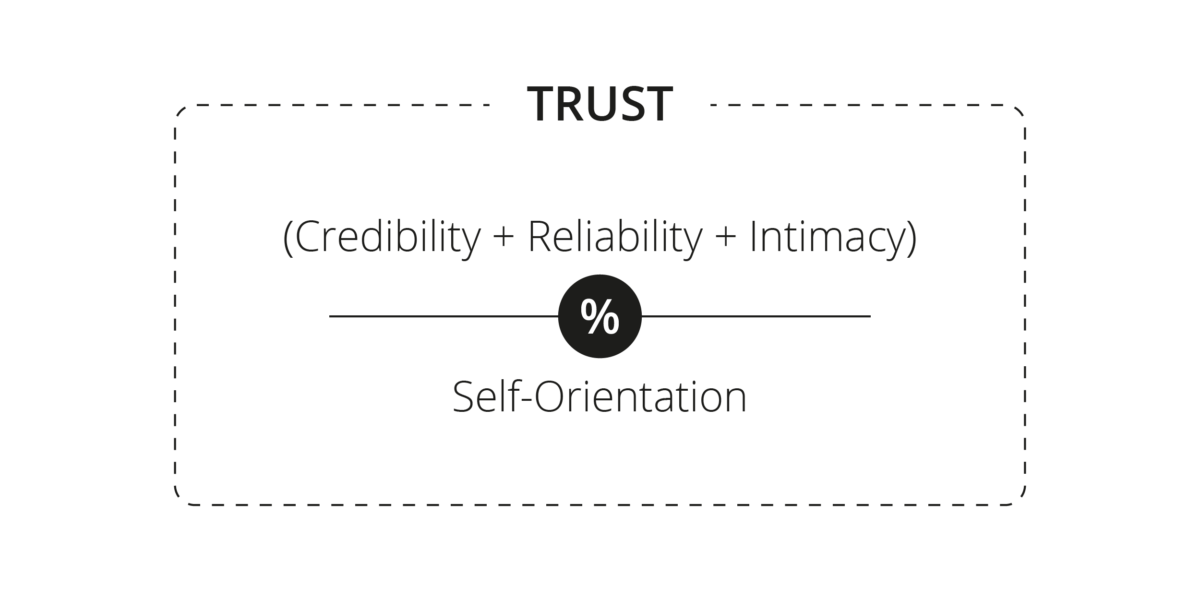
Charles Green’s Trust Equation puts it cleanly: trust = (credibility + reliability + intimacy) ÷ self-orientation. AI is busy commoditizing the entire numerator — it can sound credible, perform reliably, even simulate intimacy. What it cannot touch is the denominator: the low self-orientation that comes from a person genuinely carrying your interest and answering for the outcome.
The workslop research is that equation caught on camera. When people received workslop they didn’t just lose time — they lost faith in the sender. Offloading your thinking onto a machine and passing the output along raised your perceived self-orientation and torched your trust. As AI drives the numerator toward free, the value of the whole equation gets decided by the one term it can’t reach.
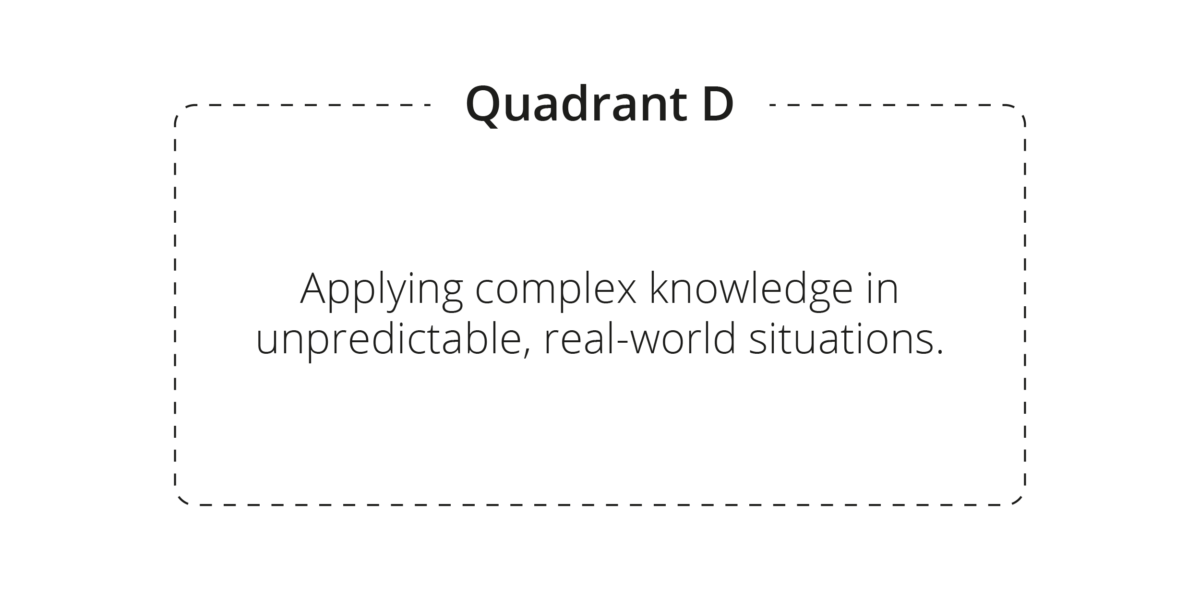
Dr. Bill Daggett’s Rigor/Relevance Framework says the same thing from another angle. AI has flooded Quadrants A and B — high-rigor recall and application in tidy, predictable conditions. That used to be an advantage. It’s now table stakes. What’s appreciating is Quadrant D: high rigor and high relevance applied in ambiguous, real-world situations where someone has to decide with incomplete information and own the result.
Judgment is only half the edge
Everything to this point describes the defensive half of the human edge — discernment, trust, the ability to own a call. But there’s an offensive half, and it may matter more.
Judgment tells you which answer to trust. Creativity produces the answer that didn’t exist yet. As AI drives the cost of routine cognition to zero, the durable advantage isn’t only knowing which of a thousand machine-generated options is any good. It’s being the source of the option no model would have generated — because it came from lived experience, from taste, from the particular way a human mind connects things that don’t obviously belong together.
This is where AI is genuinely, enormously useful — and most misunderstood. AI is an extraordinary accelerant of innovation: it compresses the distance from idea to prototype, from one question to a hundred directions worth exploring. But it accelerates a spark it cannot strike. Innovation begins in human experience and creativity, gets shaped by judgment, and gets owned through accountability. AI can make that cycle run faster than ever. It cannot start it.
Which is why the cost-cutting read of AI gets the strategy exactly backwards. The firms that win won’t be the ones that used AI to do the same things with fewer people. They’ll be the ones that used the abundance to create and innovate faster than anyone else — with the judgment to know which creations were worth betting on, and the accountability to stand behind them.

The bet
So here’s the choice, stated plainly.
You can read AI as a cost-reduction play — fewer people, cheaper output, banked efficiency — and walk directly into the Jevons trap, where the flood of cheap cognition swamps the organization and the 95% failure rate becomes your story too.
Or you can read it as Jevons predicts, and as the receipts already show: the abundance isn’t an invitation to shrink. It’s raw material. The winners and losers of the next decade will be sorted by a single question — who can still create, innovate, and own the call once answers are free. That capacity is human, it is teachable, and it is the last thing to be commoditized.
Nadella was right that AI demand will skyrocket. But the demand that matters most isn’t for compute, or even for answers. It’s for people who can create what the machine never would have, decide what’s worth doing, and stand behind it.
AI tools are table stakes. The human edge — judgment, creativity, and the accountability to own both — is the moat. Not because the machine can’t think, but because it can’t answer for what it thinks, and it can’t originate what it has never lived. That’s the one thing that was always, and only, ours.
The Motivated Mind Group builds the human edge in every working adult. This is No. 01 in our Human Edge series.
Sources: Satya Nadella, public post (Jan 2025) · MIT NANDA, The GenAI Divide: State of AI in Business (2025) · Niederhoffer, Hancock et al., “AI-Generated ‘Workslop’ Is Destroying Productivity,” Harvard Business Review (Sep 2025, BetterUp Labs & Stanford) · Ronnie Walker / Goldman Sachs Global Investment Research, Q4 2025 analysis · The Trust Equation — Charles H. Green, The Trusted Advisor · The Rigor/Relevance Framework — Dr. Bill Daggett, ICLE.
Ready to build the human edge on your team?
Drop us a line
Have something to say? We’d love that.
Contact us here.