
Neurodivergent professionals have quietly become AI’s power users. In Understood.org’s 2026 Neurodiversity at Work survey, 78% of neurodivergent employees reported using AI tools at work, against 59% of their neurotypical peers — and they don’t just use it more, they use it differently.
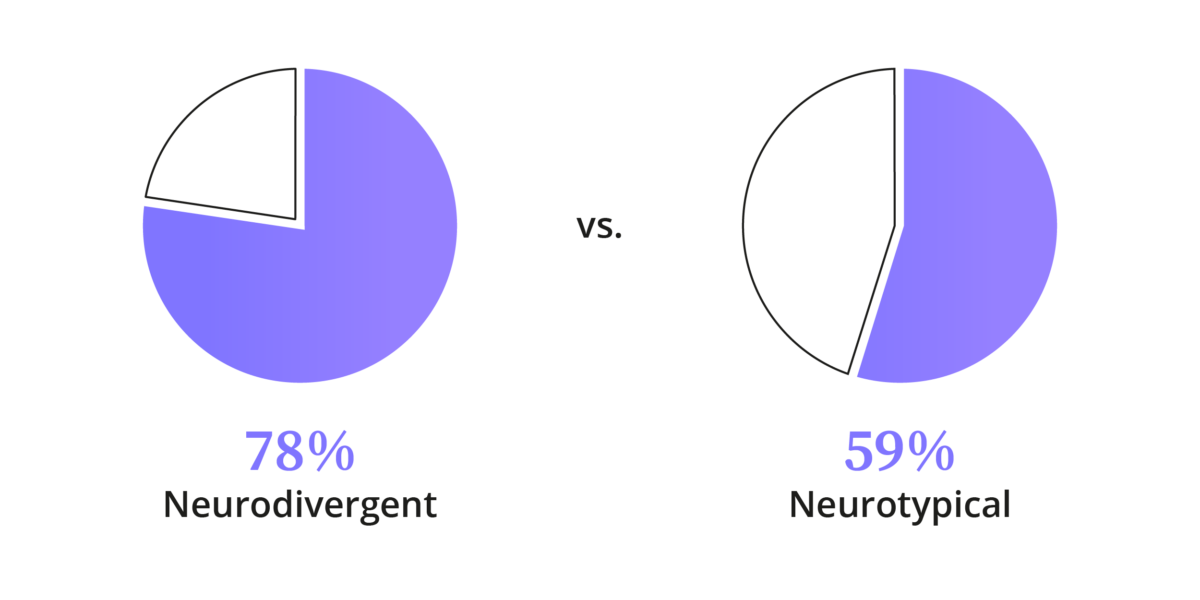
The easy explanation is that some brains are simply built for this technology. That’s a dead end: you can’t train a neurotype into your people. The more useful truth sits underneath it — what drives AI power-use isn’t a diagnosis, it’s a set of five behaviors. And behaviors can be taught.
AI floods the routine. Judgment is the high ground.
Dr. Bill Daggett’s Rigor/Relevance Framework plots how deeply a person thinks against how far they can apply it to messy, real situations. AI now does the lower-left work. What it cannot reach is Quadrant D: high-level judgment applied to ambiguous situations where the rules aren’t written. That’s exactly where the power-user behaviors live.
The five behaviors behind every AI power user
- Interrogation. Refusing to accept a fluent answer at face value.
- Decomposition. Breaking a problem into judgable parts and setting the standard before delegating.
- Divergence. Generating many approaches and deliberately seeking the edges where a tool fails.
- Reframing. Occupying a stance that isn’t your own, and auditing your own bias.
- Rebuilding. Redesigning the workflow around what the tool can and can’t do.
Naming them this way turns an identity claim into a capability claim. And a capability can be built.

The part AI can’t copy: trust
Charles Green’s Trust Equation puts credibility, reliability, and intimacy over self-orientation. AI has made the numerator cheap. What it can’t do is hold down the denominator. Low self-orientation — genuinely seeing the problem from the customer’s side — is the hardest part of trust to earn and the easiest to lose. Nowhere is that sharper than in the IT channel.
The good news: it’s teachable
A meta-analysis of 117 studies (20,000+ participants) found that explicit instruction reliably raises critical-thinking skills. The catch: these gains don’t appear as a byproduct of using a tool. You have to teach the behavior explicitly and practice it on real work.
How we build it: AMPED, then the Human Edge
At MMG, the five behaviors are trained tactically through AMPED and embedded strategically through the Human Edge, a multi-month capability engagement built on the Trust Equation and Rigor/Relevance.
The tools are table stakes. The edge is human — and it’s learnable.
Want to build judgment that AI can’t replace? Talk to MMG about the Human Edge.
Drop us a line
Have something to say? We’d love that.
Contact us here.